The amount you invoice the customer.
This affects cash flow and accounts receivable.
Billed Revenue Is Not Recognized Revenue — A Real Lesson from a Customer Project

Most subscription companies make one common mistake—treating billed revenue and recognized revenue as if they are the same. They’re not. And a recent project reminded us why this matters.
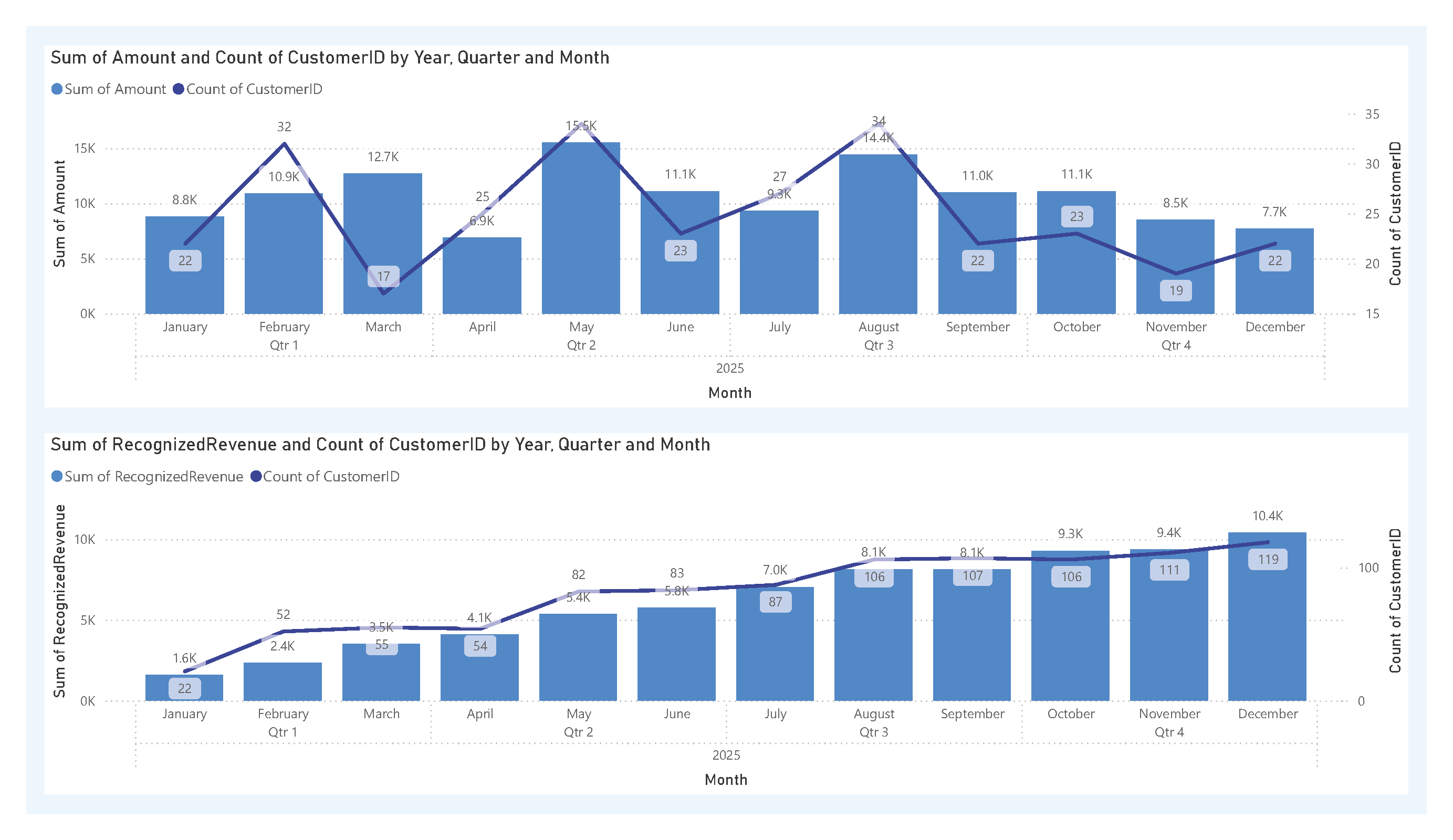
A client approached us asking for a finance dashboard to help them analyze revenue month-to-month, track growth, and forecast performance. But the moment we connected to their data, we noticed something strange: revenue spikes in random months, followed by quiet periods, even though customers were continuously subscribed.
The issue became obvious very quickly— they were recording revenue based on invoice date instead of service period.
This is one of the biggest pitfalls in subscription businesses.
Billed Revenue vs. Recognized Revenue
- Billed Revenue
- Recognized Revenue
The portion of revenue you actually earn as you deliver the service.
This affects your income statement and performance metrics.
For subscriptions—whether monthly or annual—revenue must be recognized over the duration of the service, not on the day the invoice is generated.
To help our client understand this more clearly, we walked them through two real-world scenarios.
Example 1: Annual Subscription Starting March 10
A customer subscribes to a 12-month prepaid plan on March 10 for $1,200.
What the client was doing (Incorrect)
They recognized all $1,200 in March.
Correct approach
The subscription covers 365 days, so revenue must be recognized daily.
Daily Rate: 1,200 ÷ 365 = $3.28767 per day
Below is the complete monthly recognition table:
Month
Days Delivered
Monthly Recognized Revenue
Mar 2025
22
$72.33
Apr 2025
30
$98.63
May 2025
31
$101.92
Jun 2025
30
$98.63
Jul 2025
31
$101.92
Aug 2025
31
$101.92
Sep 2025
30
$98.63
Oct 2025
31
$101.92
Nov 2025
30
$98.63
Dec 2025
31
$101.92
Jan 2026
31
$101.92
Feb 2026
28
$92.06
Mar 2026
9
$29.59
Total
365
$1,200.00
Instead of one big spike in March, revenue is now smooth, accurate, and aligned with service delivery.
Example 2: Monthly Subscription Starting March 10
A customer subscribes to a month-to-month plan, billed $100 every month, starting March 10.
Service Period
March 10 → April 9 (31 days)
Daily Rate: 100 ÷ 31 = $3.225806 per day
Here is the complete recognition table:
Month
Days Delivered
Monthly Recognized Revenue
Mar 2025
22
$70.97
Apr 2025
9
$29.03
Total
31
$100.00
Just like the annual plan, the monthly plan must be recognized based on days of service, not when the invoice is issued.
What This Meant for the Client
Once we corrected their revenue model:
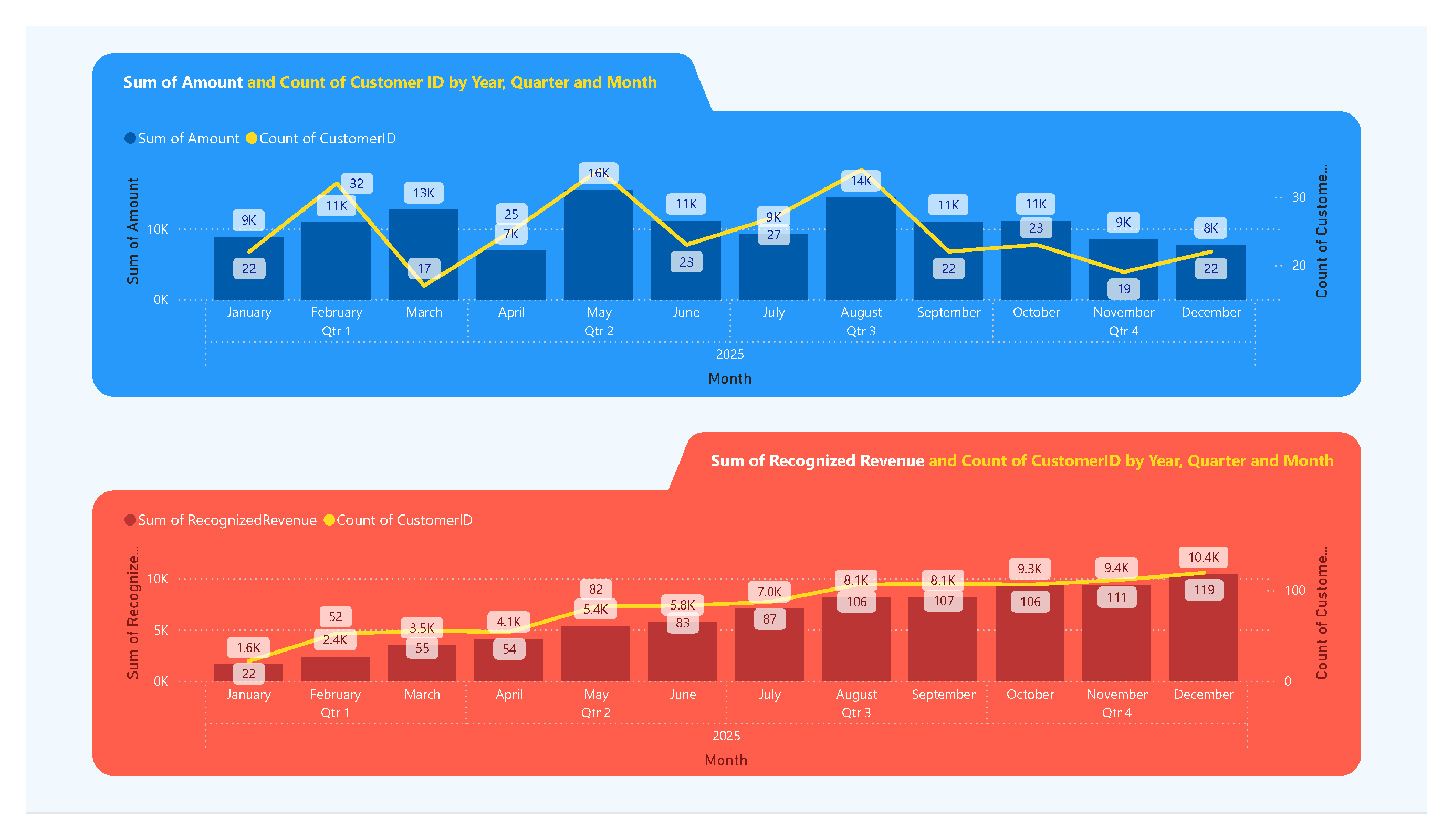
Their monthly revenue chart finally made sense: No more random spikes caused by annual invoices.
MRR and ARR became accurate: They could now show true recurring revenue to investors and accountants.
Forecasting became reliable: Because recognized revenue reflects real service periods—not billing habits.
Compliance improved: They now meet proper revenue recognition standards.
What started as a simple finance dashboard request turned into a major correction in how they recorded revenue. And ultimately, it brought clarity, accuracy, and trust to their financial reporting.
Before Correction
After Correction
Final Thoughts
Billed revenue tells you what the customer owes you.
Recognized revenue tells you what you actually earned.
Every subscription business—whether SaaS, membership, or services—must get this right. And as our client discovered, proper revenue recognition doesn’t just fix accounting; it transforms decision-making.